
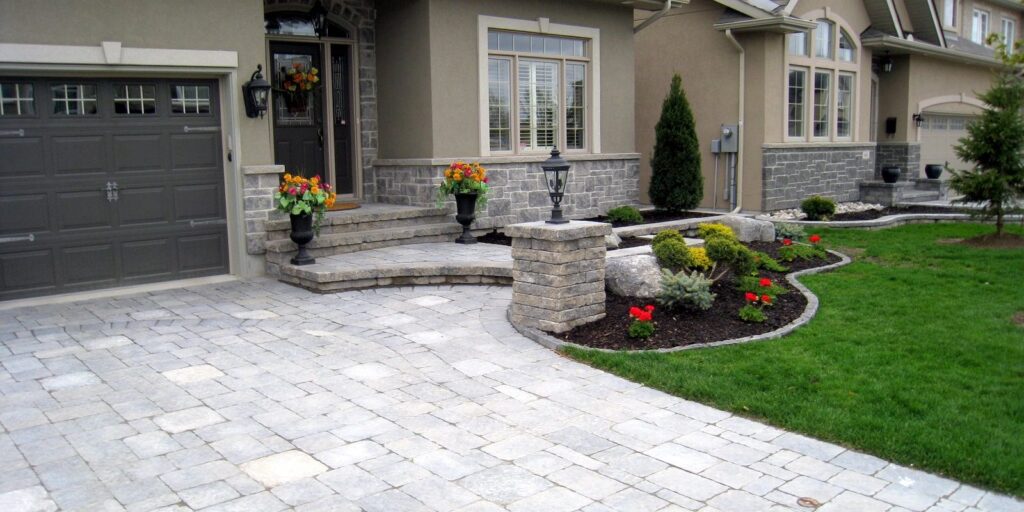

Interlock paving has become one of the most popular driveway and walkway choices in the GTA, and the reasons are straightforward: it looks significantly better than plain asphalt or poured concrete, it holds up well in Ontario’s freeze-thaw climate when installed correctly, and individual damaged pieces can be replaced without disturbing the surrounding surface. Those advantages are real, but they depend heavily on decisions made during installation that most homeowners don’t know to ask about until something goes wrong.
Understanding what interlock is, how different systems and materials compare, and what separates a well-installed driveway from one that will be spreading and settling within a decade is genuinely useful before any installation conversation begins.
What Interlock Actually Is
Interlock paving refers to a system of individual paving units, typically concrete, natural stone, or clay brick, set on a prepared granular base and held in position by edge restraints at the perimeter and joint sand packed between the units. The units don’t bond to each other or to the base with mortar or adhesive. Instead, the system relies on confinement: the edge restraints prevent outward spreading, the joint sand transfers load between adjacent units, and the interlocking geometry of many paver shapes provides additional stability under load.
This is fundamentally different from poured concrete or asphalt, both of which are monolithic surfaces that behave as a single connected unit. An interlock surface is an assembly of individual pieces, which is what makes it repairable in sections but also what makes it sensitive to the failure of any one component in the system. Edge restraints that migrate, joint sand that depletes, or a base that settles unevenly all affect the surface in ways that a monolithic surface would absorb without visible consequence at the same scale.
Types of Interlock Paving MaterialsConcrete Pavers
Concrete pavers are by far the most common interlock material in GTA residential installations. They’re manufactured in consistent dimensions, available in a wide range of colours and surface textures, and produced to standards that ensure adequate strength and freeze-thaw resistance for Ontario conditions. The vast majority of residential interlock driveways and walkways installed in the GTA over the past three decades use concrete pavers.
Within the concrete paver category, there’s meaningful variation in quality. Pavers manufactured to meet or exceed the requirements of CSA A231.2, the Canadian standard for precast concrete paving slabs, are produced with sufficient density and low water absorption to perform reliably through Ontario winters. Lower-grade products with higher absorption rates are more susceptible to surface scaling and freeze-thaw damage, and the difference between them isn’t always apparent visually before installation.
Colour in concrete pavers is produced either through pigments mixed throughout the paver body or through a surface colour layer applied during manufacturing. Through-body colour is more durable because the colour doesn’t fade when the surface layer wears. Surface-coloured pavers can show wear patterns at high-traffic points within a few years of installation. Confirming how colour is produced before selecting a specific product is worth doing, particularly for driveways where vehicle traffic is concentrated in specific wheel tracks.
Clay Brick Pavers
Clay brick pavers, sometimes called clay tumbled pavers or genuine brick pavers, are fired clay units rather than concrete products. They have a distinctly different appearance from concrete pavers, with colour variation that comes from the firing process rather than pigmentation, and a texture that typically weathers more attractively than concrete over time.
Clay brick pavers are denser and harder than most concrete pavers, with very low water absorption rates that make them inherently resistant to freeze-thaw damage. They also don’t fade over time the way concrete pavers can, because the colour is the fired clay itself rather than a pigment. These are genuine long-term performance advantages.
The constraints are cost and availability. Quality clay pavers cost significantly more than comparable concrete pavers, and the selection available through GTA suppliers is more limited. For homeowners who prioritize appearance quality and long-term colour stability over upfront cost, clay pavers are worth investigating seriously. For standard residential applications where budget is the primary constraint, concrete pavers are the practical choice.
Natural Stone Pavers
Natural stone pavers, including granite setts, limestone slabs, and various flagstone materials, bring the visual quality of quarried stone to paved surfaces. Dense stone varieties perform well in Ontario conditions; more porous stones require more careful selection for freeze-thaw resistance.
Natural stone paving in a driveway context is typically granite or hard limestone, both of which have the density and durability to handle vehicle loading and freeze-thaw cycling. Softer stones are more appropriate for pedestrian walkways and patio areas where loading is lower and the aesthetic is the primary consideration.
Installation of natural stone pavers requires more skill than concrete paver installation because the individual pieces vary in size and shape and require fitting rather than simply setting in a pattern. That additional labour time, combined with the material cost, makes natural stone paving considerably more expensive than concrete interlock for equivalent coverage areas.
Pattern and Layout Considerations
The pattern in which pavers are laid affects both the appearance and the structural performance of the installation. Running bond patterns, where each row offsets by half a unit from the row on either side, are the most common and provide reasonable stability. Herringbone patterns, where pavers are set at 45 or 90 degrees in a zigzag arrangement, provide superior interlock under load and are the recommended pattern for driveways that will carry vehicle traffic. The interlocking action of the herringbone geometry resists the horizontal forces that vehicle tyres exert on the surface as they accelerate and brake.
Pattern also affects how visible any future repairs will be. A simple running bond is relatively easy to match in a repair; an intricate pattern with multiple colours or a custom border design is harder to replicate exactly if a section needs to be reset. Homeowners commissioning complex multi-colour or multi-pattern designs should retain surplus material from the original installation for future repairs, because matching colours and patterns precisely from new production runs years later is difficult.
The Base System: What You’re Actually Paying For
In any interlock installation, the base system accounts for a significant portion of the total project cost, and it’s the portion that determines long-term performance. A homeowner comparing two quotes that differ substantially in price should be asking whether the difference is in the base specification, because a cheaper installation that uses a shallower base or skips proper compaction will fail sooner than one built to the correct standard.
The base system for a residential driveway in Ontario typically consists of a subgrade preparation step where the existing soil is excavated to the required depth and any soft spots are addressed, a compacted granular base layer of 150 to 300mm depending on expected loads and soil conditions, a thin bedding layer of coarse sand on which the pavers sit, and the pavers themselves set in the specified pattern with polymeric joint sand filling the gaps.
In clay-heavy soils, which are common across much of the GTA, a geotextile separation fabric between the subgrade and the granular base prevents clay fines from migrating upward into the granular material over time and reducing its drainage capacity. This is a relatively inexpensive addition to the base system that meaningfully extends its performance life in clay soil conditions, and any contractor working in these areas should include it as standard rather than as an upgrade.
Driveway vs. Walkway vs. Patio: Different Loads, Different Requirements
The same interlock material and system is used for driveways, walkways, and patios, but the base depth and compaction requirements differ based on the expected loading. A pedestrian walkway carrying only foot traffic can be built on a 100 to 150mm granular base. A residential driveway carrying passenger vehicles needs a minimum of 200 to 250mm. A driveway accessed by delivery trucks or other heavy vehicles needs more still, and the subgrade condition needs to be assessed to confirm it can carry the load.
Using a pedestrian-grade base specification under a driveway is one of the most common installation shortcuts that produces early failure. The slab depresses under vehicle weight, the joint sand is pushed downward, and the pavers begin to rock and settle in the wheel tracks within a few seasons. The repair requires lifting the affected area, correcting the base, and resetting the pavers, at a cost that typically exceeds the saving from the lighter base installation.
Slope, Drainage, and What Happens to the Water
Interlock paving is permeable at the joints, which means some portion of rainwater infiltrates between the pavers rather than running off the surface entirely. This is a genuine drainage advantage over poured concrete or asphalt, particularly in municipalities that charge stormwater levies based on impervious surface area. However, the permeability of a standard interlock installation with polymeric sand joints is modest, and the majority of rainfall still runs off the surface and needs somewhere to go.
The surface should slope at a minimum of 1 to 2 percent away from the house to prevent water from pooling against the foundation. The drainage destination matters as much as the slope: directing runoff toward a permeable garden bed, a catch basin, or a rear yard drainage point is appropriate. Directing it toward a neighbouring property or pooling it in a low spot in the yard creates new problems rather than solving the original one.
For homeowners in Ajax interlock installation work and across Durham Region, where seasonal soil moisture in clay-heavy areas is high after snowmelt, adequate surface drainage slope and a well-designed base system are particularly important for preventing the base saturation that leads to interlock heaving and settlement.
Edge Restraints: Why They’re Non-Negotiable
Edge restraints are the structural perimeter of any interlock installation. They prevent the outer courses of pavers from spreading outward under load, and without them the entire surface gradually migrates. The restraint is typically a plastic or aluminum channel installed at the perimeter of the paved area and pinned to the granular base with steel spikes.
The quality of edge restraint installation is invisible once the work is done, which makes it easy to cut corners on. Restraints that are set without adequate pinning, backfilled with loose soil instead of compacted material, or interrupted at transitions to other surfaces migrate readily under vehicle loading. The result is visible within a few years as a gap opens between the outer courses of pavers and the adjacent surface.
Transitions between the interlock and other surfaces, such as a garage apron, a concrete sidewalk, or a step, are edge conditions that need specific attention. The transition detail determines whether the two surfaces stay flush or develop a height difference over time as the interlock settles or heaves relative to the fixed adjacent surface.
Getting an Accurate Quote
Interlock installation quotes vary significantly in what they include, which makes comparing prices without understanding scope a reliable way to make a poor decision. The lowest quote often achieves its price by reducing base depth, skipping geotextile separation, using lighter edge restraint, or substituting standard joint sand for polymeric. None of those savings are visible in the finished installation, but all of them affect how long the installation performs.
When reviewing any interlock quote, the following should be explicitly specified rather than assumed: base depth in millimetres, whether geotextile separation is included, edge restraint type and installation method, joint sand type, surface drainage slope, and whether subgrade preparation is included or assumed to be in adequate condition. A quote that addresses all of these specifically is a quote that can be compared meaningfully to others. One that specifies only surface area and material type leaves the most important variables undefined.
For homeowners who are also dealing with masonry work elsewhere on the property, an interlock installation that’s scoped alongside brick repair, parging, or chimney work allows the contractor to address sequencing questions, particularly around any excavation near the foundation, in a way that prevents one scope from disrupting another. A masonry contractor who handles both hardscaping and structural masonry can provide that coordination as part of a single project assessment rather than requiring separate conversations with separate trades.
FAQHow long does interlock installation take for a standard residential driveway?
A standard two-car driveway installation typically takes two to four days from excavation to final joint sand compaction, depending on crew size, base conditions, and the complexity of the pattern and edge details. Sites requiring significant subgrade remediation or custom pattern work take longer. Most contractors schedule the work as a continuous block rather than spreading it over multiple visits, so the practical timeline from start to completion is usually within a single week for a straightforward residential scope.
Can interlock be installed in winter in Ontario?
Technically yes, since interlock installation doesn’t involve mortar or concrete that requires above-freezing temperatures to cure. However, frozen subgrade makes excavation difficult and compaction of the granular base unreliable, because frozen material compacts differently than unfrozen material and can settle when it thaws. Most contractors decline interlock work during frozen ground conditions for this reason, and the base performance of winter-installed interlock is generally less reliable than work done during the main season.
Does interlock add resale value to a GTA home?
A well-maintained interlock driveway and front walkway consistently improves first impressions and contributes positively to a home’s curb appeal, which affects both buyer interest and perceived value. Whether the full installation cost is recovered in resale value varies by neighbourhood and market conditions. In areas where interlock is the norm, its absence can be a detractor; in areas where it’s less common, it’s an upgrade that buyers notice positively. The value contribution is more consistent for front-facing installations that affect curb appeal than for rear patio work that buyers may not see during a typical showing.
Is it possible to add radiant heating beneath an interlock driveway?
Yes, and it’s a practical option for homeowners who want to eliminate snow removal from a driveway. Electric heating cables or hydronic tubing are installed in the bedding layer during the initial installation, with the controls inside the home. The system is embedded during installation rather than retrofitted, so it needs to be specified before work begins rather than added later without significant disruption. The installation cost is meaningful, but the operating cost and the elimination of de-icing salt use, which reduces paver surface deterioration over time, make it worth evaluating for homeowners with a long planning horizon.